
CNC press brake is widely used in sectors ranging from aerospace to construction. This versatile machine plays a vital role in producing both complex custom components and high-volume standard parts. However, one critical factor often overlooked when evaluating a CNC press brake is its axis configuration.
The axis configuration determines how a press brake moves and operates, directly influencing its precision, flexibility, and automation capabilities. Whether you’re targeting high-speed production, intricate bending operations, or seamless integration with automated systems, choosing the right axis setup is essential, especially when supplying to demanding markets such as Europe and North America.
At LONGBOW, we specialize in guiding manufacturers toward the best CNC solutions for their specific production goals. In this guide, we’ll explore how different axis configurations impact machine performance and how to select the optimal setup based on your application complexity, output requirements, and future expansion plans.
Why Is the “Axis Configuration” of CNC Press Brake So Critical?
The axis configuration of CNC press brakes plays a pivotal role in optimizing manufacturing processes for several key reasons:
Increased Control and Capability
Each additional axis on a CNC press brake enhances the machine’s control ability. With more axes, the machine can perform more complex movements, providing higher precision and more advanced bending capabilities. For example, an extra axis might allow the machine to adjust the back gauge height or fine-tune the bend’s angle, contributing to a more accurate and versatile bending process.
Improved Flexibility and Productivity
A machine with more axes is better equipped to handle intricate parts and customized batch production. When producing complex components, the added axes allow the press brake to make precise adjustments on the fly, increasing the machine’s overall efficiency. This flexibility significantly boosts productivity and reduces downtime, as fewer retooling steps are required between different jobs.
Demand for Automation and High Precision
In recent years, there has been a growing demand for automated, high-precision bending solutions, particularly from European and American customers. With the increasing focus on efficiency and accuracy, having a CNC press brake with more axes allows for smoother automation integration, ensuring consistent results and reducing human error during the production process. This makes the machine more appealing to customers who value precision and automated systems in their manufacturing operations.
Functions and Applicable Scenarios of Various Axis Configurations
The axis configuration of a CNC press brake defines how the machine moves and bends sheet metal, directly influencing its precision, flexibility, and range of applications. Below is a breakdown of the most common axis setups and their ideal usage scenarios:
2-Axis Configuration (Y + X)
This basic setup includes:
- Y-axis – Controls the vertical movement of the press beam.
- X-axis – Adjusts the back gauge horizontally.
A 2-axis CNC press brake is ideal for straightforward bending operations, such as 90-degree bends and simple geometric shapes. Common in small to mid-sized workshops, this configuration is best suited for:
- Low-volume production
- Straight-line or uniform bends
- Basic fabrication tasks like enclosures, boxes, trays, or small panels
It is valued for its simplicity, affordable cost, and low maintenance, making it an excellent entry-level choice for manufacturers transitioning to CNC technology.

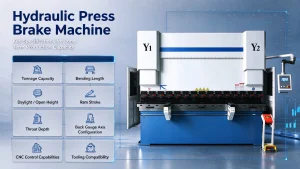
4-Axis Configuration (Y1, Y2, X, R)
Building on the 2-axis setup, the 4-axis press brake adds:
- Y1/Y2 – Independent control of each hydraulic ram side for enhanced precision.
- R-axis – Vertical movement of the back gauge.
This configuration enables more accurate multi-height bending and complex layouts, allowing for:
- Medium-volume production
- Fabrication of parts with varying flange heights
- Frequent gauge repositioning and flexible setup
Favored by fabricators in the North American market, the 4-axis configuration strikes a balance between performance and ease of operation, offering flexibility without overcomplicating the process.

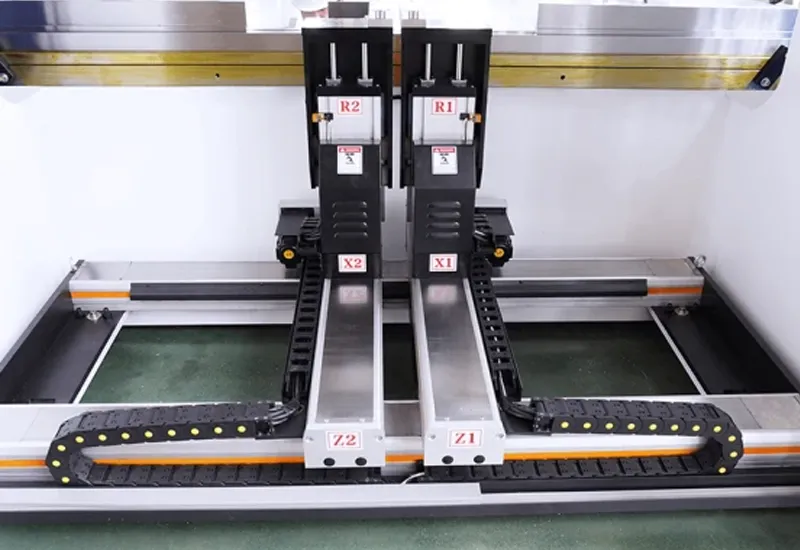
6-Axis and Higher (Y1, Y2, X, R, Z1, Z2, etc.)
Advanced CNC press brakes with six or more axes deliver exceptional capabilities for precision manufacturing. Added axes typically include:
- Z1/Z2 – Lateral movement of individual back gauge fingers.
- Optional axes – For angle measurement, automatic tool changes, or robotic integration.
These high-end machines enable:
- Asymmetrical and irregular shape bending
- Multi-step complex part processing
- Rapid setup for high-mix/low-volume production
Widely used in aerospace, rail transit, energy, and other high-precision sectors—especially across Europe—these machines support automation, accuracy, and efficiency at scale. They are ideal for manufacturers seeking advanced control, reduced manual adjustments, and full digital integration.
How Do We Customize the Number of Axes for Customers?
No two manufacturing lines are the same. That’s why at LONGBOW, modular configuration is at the heart of our design philosophy. Whether you’re a startup workshop or a tier-one supplier, we tailor press brake solutions to your exact requirements.
Our customization process includes:
Technical Consultation: We analyze your material, part drawings, and expected tolerances.
Volume & Labor Analysis: Based on production size and labor skill level, we recommend automation-compatible features to support lean manufacturing environments.
ROI Optimization: We help businesses calculate the return on investment across 2, 4, 6, or even 12-axis configurations.
Smart Add-ons: For clients aiming for full automation, we integrate accessories like automatic tool changers, safety light curtains, and offline programming software.
Customization isn’t limited to the axes only—it touches everything from beam length, tonnage capacity, to interface language and electrical standards. Whether you’re active in Germany, Canada, or Brazil, we ensure compatibility with local regulations and industrial expectations.
Different Preferences for CNC Press Brake Configurations in the European and American Markets
CNC press brake requirements vary significantly by region, driven by industry demands, labor considerations, and regulatory standards. Understanding the key differences between European and North American markets is essential for manufacturers, exporters, and equipment suppliers aiming to serve global clients effectively.
European Market Trends
In Europe, precision and automation are top priorities—especially in advanced sectors such as aerospace, rail transportation, and medical device manufacturing, where tolerances are extremely tight and production traceability is critical. Key preferences include:
- High-axis configurations (6 to 12+ axes) to accommodate complex geometries and demanding production cycles.
- Strong emphasis on automation compatibility, including robotic integration and automatic tool changers.
- Compliance with CE standards and increasing alignment with Industry 4.0 principles—real-time monitoring, digital connectivity, and intelligent data feedback are becoming standard.
- Preference for machine traceability, ensuring every step of the production process can be tracked and audited.
North American Market Trends
In contrast, the North American market tends to emphasize cost-efficiency, flexibility, and operator accessibility, particularly in job shops and mid-sized fabrication businesses. Typical characteristics include:
- 4-axis configurations (Y1, Y2, X, R) dominate due to their balance of functionality and ease of use.
- High demand for user-friendly interfaces and minimal operator training requirements, making machines more accessible to varied skill levels.
- A growing shift toward automation, with increasing adoption of robotic arms, vision systems, and smart production cells.
- Investment decisions often revolve around ROI and production versatility, especially in contract manufacturing environments.
Meeting Global Demands
For companies looking to export or scale operations across regions, aligning with local expectations is crucial. At LONGBOW, we offer scalable CNC press brake solutions tailored to each market—from reliable, cost-effective models ideal for North American workshops to advanced, multi-axis systems ready for Europe’s high-spec production lines.
Manufacturer’s Advice: How to Choose the Right Number of Axes?
Choosing your CNC press brake axis configuration doesn’t have to be a guessing game. Here are a few non-negotiables we recommend evaluating:
Part Complexity: Are you producing straight bends or multi-directional, asymmetrical forms?
Precision Requirements: The tighter the tolerance, the more finesse is needed. More axes help fine-tune every move.
Production Volume: In high-volume order scenarios, automated or multi-axis options reduce bottlenecks and labor dependency.
Changover Frequency: If you’re switching part types often, a flexible axis setup speeds up reprogramming and tool changes.
Workforce Skill Level: For teams with limited CNC experience, a simpler setup with intuitive control will reduce training costs.
Growth Planning: Don’t just think about today’s needs. Consider the next 3 to 5 years. Opting for a machine with expansion capabilities gives your business room to grow.
Our team offers step-by-step support for selection, from software simulation to hands-on testing. We don’t just sell machines—we help you future-proof your production line.
Conclusion
Selecting the right CNC press brake axis configuration has far-reaching effects on your production flexibility, cost efficiency, and scalability. Whether you’re aiming for a straightforward manual setup or a full-fledged automated system, the right axis configuration will align with your long-term manufacturing goals.
At LONGBOW, we combine technical expertise with deep insights into international markets to provide press brake solutions that fit you—not the other way around. Our modular machines cater to beginners and advanced users alike, with support systems that make onboarding fast and efficient.
Choosing a CNC press brake is more than just comparing specs—it’s building a future-ready shaping system that meets the demands of a dynamic fabrication world. Reach out to our team today to get personalized guidance and bring your operations to the next level.