Understanding the different types of press brake tooling and how they affect both precision and productivity can help manufacturers make smarter tooling choices, reduce setup times, and improve part consistency. In this article, we’ll explore essential tooling types, their materials, their impact on performance, and how to select the right tools for your specific bending needs.
Basic Knowledge of Press Brake Tooling
Before diving into specific types of press brake tooling, it’s helpful to understand the structure and function of these tools. A standard press brake setup includes an upper tool (punch) and a lower tool (die). The punch moves downward into the die, pressing the metal sheet into a desired angle or shape.
Tooling Classification
Press brake tooling can be classified by:
1. Function (bending, offsetting, hemming)
2. Shape (V-type, radius, gooseneck, etc.)
3. Application scenario (standard, precision, custom)
Each tool type is designed to meet specific bending requirements, and pairing the wrong tooling with the wrong material or angle can lead to poor results or even tool damage.
Material Composition
Tooling is typically made from high-strength tool steels. Common materials include:
1. 42CrMo: High toughness and wear resistance, suitable for heavy-duty bending.
2. T8 and T10: High-carbon steel with good hardness, used for standard bending applications.
3. Cr12MoV: Excellent for long production runs due to its durability and resistance to deformation.
Tool hardness directly affects wear resistance, bending accuracy, and tool life. For thick or high-strength materials, a harder material like 42CrMo is preferred. For thinner sheets or soft metals, T8 may be sufficient.
Key Functions
1. Upper Mold (Punch): Shapes the bend by pressing into the workpiece.
2. Lower Mold (Die): Supports the sheet metal and defines the final angle or radius.
3. Shank or Clamping System: Ensures secure attachment to the press brake.
Correct tooling setup ensures that bending is consistent, accurate, and repeatable, which is vital for producing high-quality parts at scale.

Analysis of Common Press Brake Tooling Types
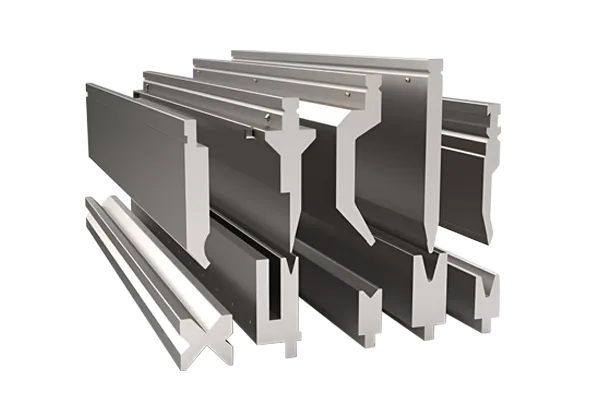
There are many types of press brake tooling, each suited for different bending tasks. Let’s take a closer look at the most commonly used ones and how they affect your operation.
1. Standard V-Die
Standard V-dies are the most commonly used tooling for bending operations. They are designed for general-purpose bending, particularly for materials of varying thicknesses. The V-shape helps control the bend angle and allows for efficient bending of flat materials. However, the die’s size and the material’s thickness can affect the bend’s accuracy and quality, so it’s essential to select the right V-die for each specific task.
2. Gooseneck Punch
The Gooseneck Punch, also known as the eagle’s beak, is designed to resolve interference issues when bending materials. It’s ideal for making multiple bends without the risk of the material getting caught between the punch and die. This type of tooling is highly effective in scenarios where deep bends or complex forms are required.
3. Radius Tooling
Radius tooling is used specifically for bending materials to create rounded corners or R-shaped bends. It helps improve the surface quality of the finished product, reducing the likelihood of cracks or damage to the material. This tooling is especially beneficial for applications where the aesthetic or structural integrity of the bend is critical.
4. Offset Tooling
Offset tooling is used for creating special shapes or stepped bends. It is especially useful when bending materials with varying thicknesses or creating complex geometries that would be challenging with standard dies. This tooling also reduces the need for multiple processing steps, improving overall efficiency.
5. Multi-V Die
A Multi-V Die is designed for bending materials of varying thicknesses by providing multiple V-shaped slots. This versatile tooling offers flexibility, allowing operators to adjust the die to suit different materials and production needs. It enhances both the adaptability and efficiency of the bending process, making it a valuable tool for high-volume production.
The Impact of Different Tooling Types on Bending Accuracy and Efficiency
Tooling selection directly affects the accuracy of your bends and the efficiency of your production line. Each tooling type offers specific benefits, but also comes with trade-offs.
Accuracy Factors
1. Die Opening Width: A mismatch between material thickness and V-width can cause angle variation.
2. Tool Wear: Over time, repeated use can wear down tooling surfaces, affecting bend consistency.
3. Springback Compensation: Some tools are better suited for minimizing material springback.
4. Tool Matching: Proper alignment between the punch and die ensures consistent angles and dimensions.
Efficiency Factors
1. Tool Change Time: Multi-V dies and standardized punches can reduce downtime.
2. Positioning Speed: Precision-ground tooling with locating features speeds up setup.
3. Adaptability: Tools like gooseneck and offset punches allow for complex parts without additional fixtures.
Balancing Accuracy and Speed
While high-precision tools may slow down production due to careful setup, they reduce rework and material waste. On the other hand, fast-change tooling may boost throughput but require more frequent quality checks. Manufacturers must find the right balance based on their production goals.
Summary
Understanding the function and application of common press brake tooling types such as standard V-dies, gooseneck punches, radius tools, offset tooling, and multi-V dies allows you to make smarter decisions in your workshop or production line.
By choosing the right tooling based on your materials, part design, and production needs, you can reduce downtime, improve accuracy, and increase throughput — all while maintaining the high standards your customers expect.
At LONGBOW, we combine technical expertise with advanced manufacturing to deliver high-performance press brake tooling that supports your success. Whether you’re building prototypes or running full-scale production, we’re here to help you find the right tools for the job. Contact LONGBOW today for expert advice, custom solutions, and world-class support.